| Dantiscus Lab |

|


| Dantiscus Lab |
|
Biography
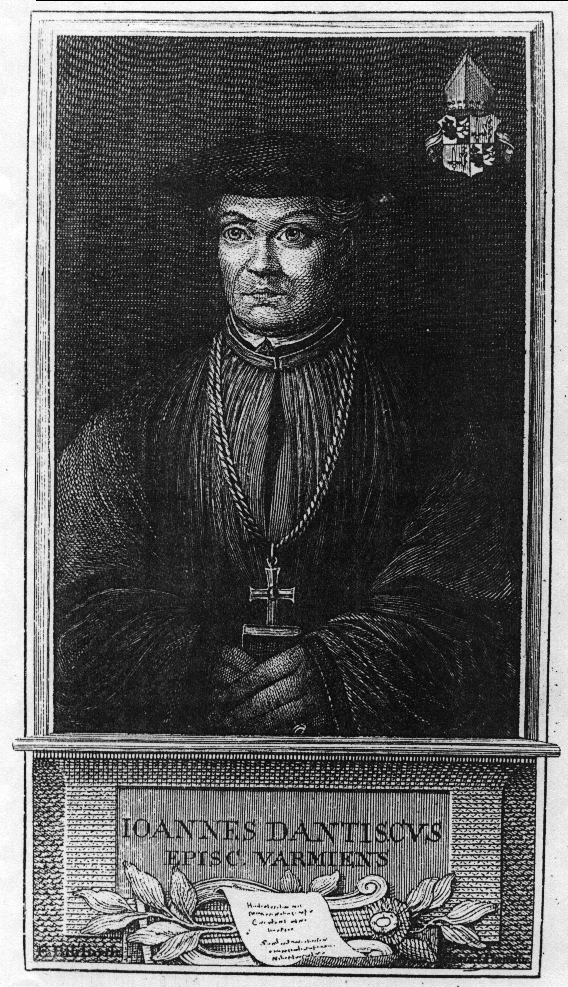
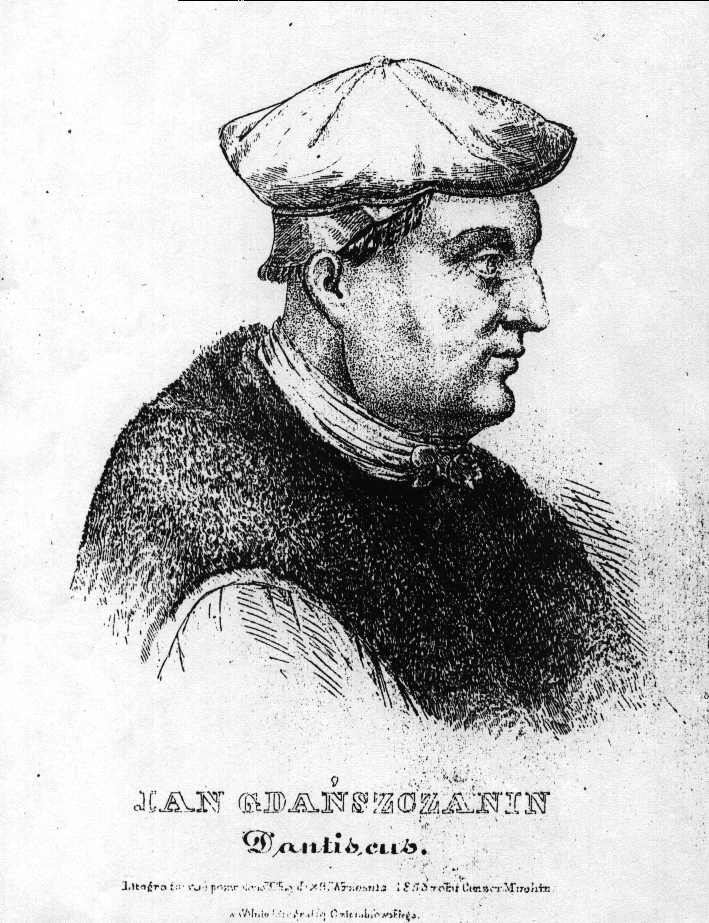
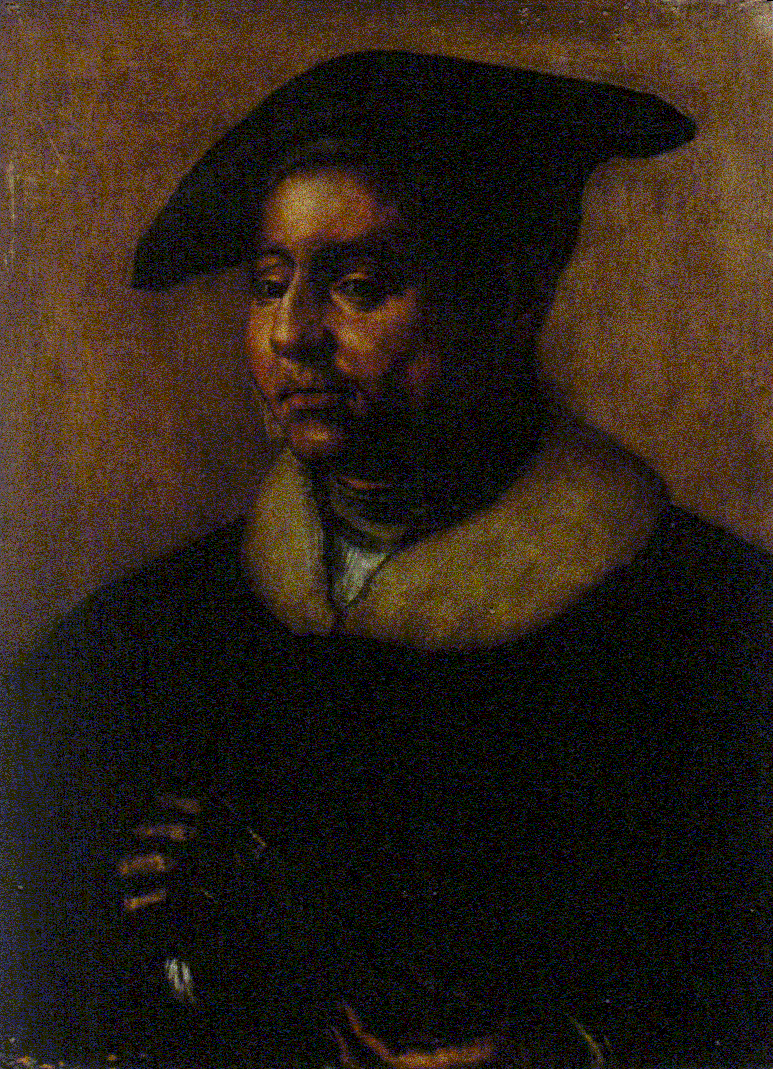
John Dantiscus was born on
November 1, 1485 in Gdańsk, in a burgher family. His father was the
Gdańsk brewer and merchant Johannes Flachsbinder (+before 1532), his
mother - Kristine Schultze (+1539). Dantiscus' father came from the
Lower German family von Höfen which had settled in Prussia. Ruined after
the Thirteen Year War, he settled in Gdańsk as a rope-maker, hence the
name later used in the family - Flachsbinder. Dantiscus had two younger
brothers - Bernard and George, and four sisters (three of them known
by name: Katharina, Ursula and Anna).
The name, or rather nickname "Dantyszek" is a Polonized version of the word Dantiscus - a Gdańsk man. Next to Ioannes de Curiis (which is a literal Latin translation of Johannes von Höfen), the name Ioannes Dantiscus is the form most often used by Dantiscus before he became a bishop. Dantiscus sometimes, though rarely, used the German form von Höfen and the nickname Flachsbinder, the latter also in the Greek translation - Linodesmon. I have seen the Polish form Dantyszek, which functions in Polish academic literature as the main form of his name, only once in manuscripts from the times of Dantiscus. He himself certainly never used it. He was a German speaker due to his home upbringing, and his known texts are in Latin and German.
Dantiscus completed the
parish school in Grudziądz. In late 1499 / early 1500 he studied at
the University of Greifswald. In the years 1500-1503 (with breaks) he
studied at the Academy of Cracow, where, having passed his exams in the
trivium, he obtained a baccalaureate degree. His tutor in Cracow was
Paweł of Krosno. In November 1505 Dantiscus received a subvention from
Alexander Jagiellon enabling him to continue his studies in Italy. From
Gdańsk, he traveled through Denmark, France and Germany to Venice, and
from there - clearly seeing practical experience to be the best university
- by sea via Corfu, the Peloponnese, Crete, Rodos and Cyprus to Jaffa.
He then went on a pilgrimage to the Holy Land, during which he went as
far as the border of Arabia. On his way back he stopped at Sicily, Naples,
Campagna and Rome. He returned to the court of Sigismund the Old in February
1507.
Dantiscus' court career
already began during his studies, circa 1500. In 1504 he was the royal
scribe. In 1507-1515, as the referendary for Prussian affairs at the
court of Sigismund the Old, he was an envoy to Prussian towns and to the
Prussian assemblies.
In 1515 he accompanied
the king to the Pressburg-Vienna congress. During the congress he
was appointed secretary of the Polish legation at the emperor's court.
From that moment until 1532, his diplomatic career continued nearly
uninterruptedly. In the course of that career, Dantiscus was an envoy
to the courts of the emperors Maximilian and Charles V, the king of Bohemia
and Hungary and subsequently the king of Rome - Archduke Ferdinand, king
of England Henry VIII, the Saxon prince Georg, princess Margaret - the
regent of the Netherlands, and the exiled Danish king Christian II. His
diplomatic activity, valued highly by the Polish royal court as well as the
imperial court, concerned important issues of King Sigismund the Old's
foreign policy, primarily Turkish affairs, the relations between Poland
and the Teutonic Knights, the king's marriages and his children, finally
the Italian heritage of Queen Bona - the famous "Naples sums" - first the
legacy of Queen of Naples Joanna IV left to Isabel of Aragon, and then the
inheritance left after the death of Isabel of Aragon. Dantyszek returned
to Poland for good in 1532. The last episode in his diplomatic career was
his legation, together with Janusz Latalski, to the King of Rome Ferdinand
Habsburg on the matter of Sigismund August's marriage to Elizabeth Habsburg.
While he was fulfilling
his official functions, Dantiscus established a great many contacts
in the academic and cultural community of Renaissance Europe. His love
of fun is known from as early as his Cracow period, when he and some
friends founded a society of drinkers and guzzlers (bibones et comedones).
He believed, probably rightly, that establishing personal contacts with
the great people of his world was one of the main tasks of a diplomat,
so he eagerly combined diplomatic activity with a rich social life. The
friendships formed in the years of his diplomatic travels lasted a long
time after Dantiscus returned to Poland, e.g. with Erasmus of Rotterdam,
Ferdinand Cortéz, the imperial diplomats Cornelis De Schepper and Sigmund
Herberstein, Christian II's chancellor Godschalk Eriksen, the Spanish humanist
Alonso Valdes, philologists such as Jan van Campen, Lazaro Bonamico, Conrad
Goclenius, the geographer and astronomer Gemma Frisius, the German poet Helius
Eoban Hessus, the banker Anton Fugger, factors of the Welzers' bank Albrecht
Cuon, Hieronymus Sailer and Heinrich Ehinger, and many other personages of
the political, cultural and economic elite of the time. These friendships
were continued for many years through correspondence. The list of Dantiscus'
correspondents known to us today includes about 350 names.
Dantiscus was a neo-Latin
poet valued by his contemporaries. His poetic output dates back to his
student days. In 1517 he received a poet's laurels from Emperor Maximilian.
He wrote works from different poetic genres throughout his life - epigrams,
elegies, epithalamia, silvae, occasional poems, epitaphs. A collection
of his religious hymns was published near the end of Dantiscus' life.
His poems, like his letters, include a variety of topics - court life,
eroticism, politics, history, mythology, autobiographical elements, and
finally theology. As for his prose, apart from his correspondence, documents
and envoy's speeches, the only known examples are a short description of
a visit to Martin Luther, a report from the Battle of Obertin, and the
brochure Explanatio de christiana fide, written as a preface to a catechism
for use in the Warmia diocese.
As a reward for his diplomatic
activity, Dantiscus received church benefices: in 1521 the parish of
Gołąb, in 1523 the parish of the Church of the Holy Virgin Mary in Gdańsk,
in 1529 the Chełmno canonry, in 1530 - the Chełmno bishopric, and finally
in 1537 he became the bishop of Warmia, and held this office until his
death in 1548.
Though Dantiscus kept in
touch with the initiators and supporters of church reform - he exchanged
correspondence with Philip Melanchthon, knew Luther personally, and
was friends with Erasmus of Rotterdam - as a church official in Prussia
he sharply counteracted the spread of the Reformation.
Being a member of the
Prussian Council when he was bishop of Chełmno, and its chairman when
he was bishop of Warmia, Dantiscus was engaged mainly in local politics
and mediated in the Council's contacts with the court of Sigismund the
Old. He also maintained animated contacts with the court of Prussian
Prince Albrecht Hohenzollern. Copies of fragments of correspondence that
Dantiscus received from all over Europe, which he attached to his letters
to Albrecht, were often a source of information for the prince on current
political events.
As bishop of Chełmno and
Warmia, Dantiscus also contributed to the development of education
in his dioceses. He was an effective patron of the restitution of the
deteriorating school in Chełmno into a new, Catholic school in the humanities
whose high standards aimed to bring it on a par with rival Protestant
schools. He turned Lidzbark Warmiński into an academic and cultural center.
He founded the episcopal library, collected works of art (paintings,
sculptures, beautiful and valuable utility items), kept artists at the
bishop's court (e.g. the painter H. Heffner), supported the publication
of his friends' works (e.g. Jan van Campen). He also funded foreign scholarships
for talented young people (e.g. Eustachius Knobelsdorf, Stanislaus Aichler).
His brothers Georg and
Bernard took part in Dantiscus' diplomatic travels, as members of the
legation suite. During his term as bishop Dantiscus took care of his
cousins (Caspar and John Hannow, John Lemann, John de Curiis Hartowski),
paying for their education. Being the eldest son,
Dantiscus
While he was in Spain (1519,
1522-23, 1524-29) Dantiscus started an informal family in Valladolid - he
consorted with Isabel Delgada, with whom he had a daughter, Juana Dantisca
(1527- after 1592) and a son, Juan (1529 - ~ 1531). For several years after
the children were born, Dantiscus took care of them and their mother through
friends. Later, as a result of various misunderstandings, the contacts were
broken off. From among Juana Dantisca's many children, four sons are counted
among the outstanding Spanish humanists: Antonio Gracián was the trusted
royal secretary and librarian of Philip II; Jeronimo Gracián was a theologian,
a mystic writer, reformer of the Carmelite Order and confessor to St. Teresa
of Avila; Lucas Gracián was a writer whose great contribution to Spanish
literature was the adaptation of Giovanni della Casa's Il Cortigiano (El
Galateo Espanol), and he was also the court chaplain and the royal notary;
Thomas Gracián was a royal secretary and a translator from French.
Dantiscus died in Lidzbark Warmiński on October
27, 1548. He most probably left no will, and preserved documents show
that his assets were split between his siblings in Prussia and the Warmia
chapter.
Anna Skolimowska |